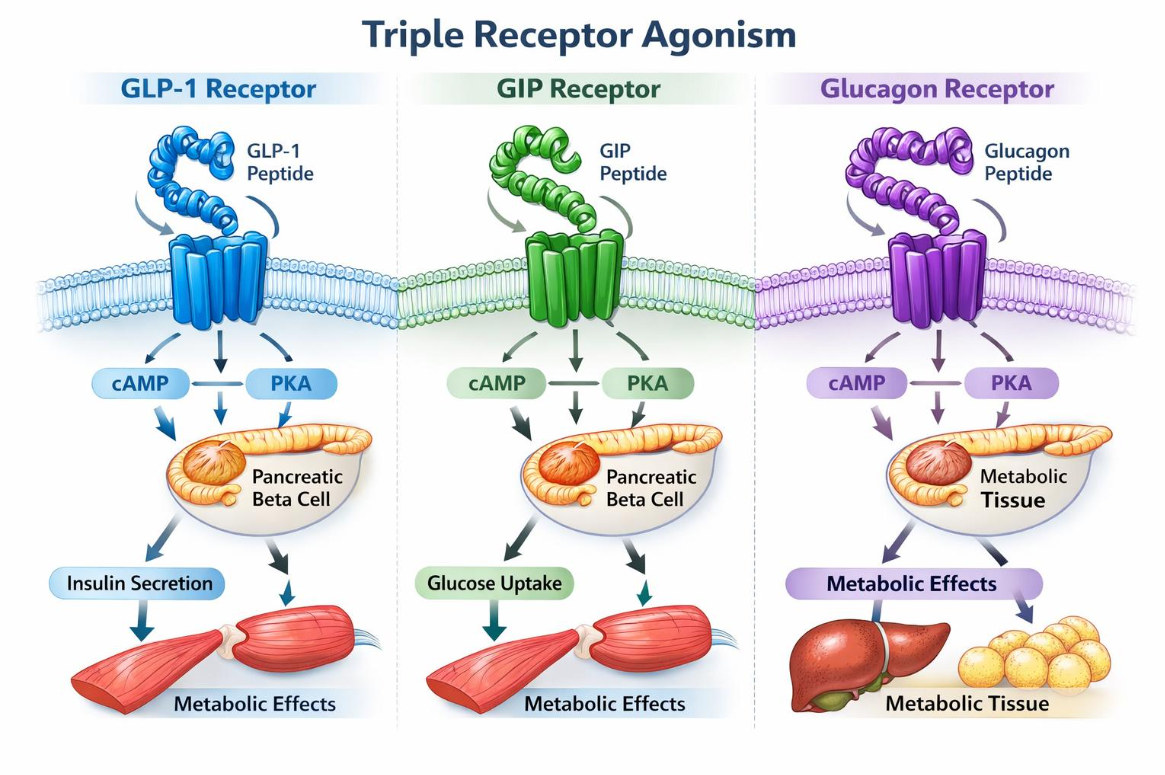

Retatrutide has attracted significant attention in obesity and metabolic research because it works differently from many existing weight-management medicines. Rather than targeting just one or two hormone receptors, this experimental peptide is designed to activate three: GLP-1, GIP, and glucagon.
But what is retatrutide, how does it work, and what have scientists discovered about its potential effects on body weight and blood sugar?
In this beginner-friendly guide, we explain the science behind retatrutide, examine important clinical research findings, compare its mechanism with semaglutide and tirzepatide, and discuss what researchers still need to learn about its safety.
Important: Retatrutide remains an investigational medicine. It has not been approved for general public use, and its safety and effectiveness continue to be evaluated. Research findings should not be interpreted as a recommendation to use products sold online.
What Is Retatrutide?
Retatrutide, also known by its research code LY3437943, is an experimental peptide developed by Eli Lilly and Company. It is described as a triple-receptor agonist because it activates three hormone receptors involved in metabolic regulation.
To understand this term, consider how the body uses hormones. Hormones act as chemical messengers, helping different organs communicate and coordinate activities such as appetite, digestion, and blood sugar regulation.
Retatrutide is designed to interact with three of these signalling systems:
- GLP-1: A hormone pathway involved in appetite regulation, digestion, and blood sugar control.
- GIP: A hormone pathway that helps regulate the body’s response to food, including insulin release.
- Glucagon: A hormone pathway involved in managing energy availability and blood sugar.
By targeting all three receptors with a single molecule, researchers hope to understand whether combining these signals can produce meaningful effects in people with obesity and related metabolic conditions.
According to Eli Lilly’s overview of retatrutide, the compound is being evaluated in clinical trials for obesity, type 2 diabetes, and several related health conditions.
However, an investigational medicine is not the same as an approved treatment. Its final benefits, risks, and appropriate medical uses depend on the available evidence and regulatory assessment.
How Does Retatrutide Work?
The retatrutide mechanism of action involves three separate but related hormone receptor pathways. Each pathway contributes different signals to the body’s metabolic processes.
Think of these pathways as three communication channels. Activating them together may produce a different overall response than activating just one or two.
1. GLP-1 receptor activation
GLP-1 stands for glucagon-like peptide-1. It is a hormone released by the body, particularly in response to food.
This hormone helps regulate blood sugar and plays a role in appetite. GLP-1 receptor activation can also slow the movement of food out of the stomach.
For medicines that act on this pathway, these effects can contribute to feeling full and eating less. The precise effects depend on the particular medicine and the individual.
Semaglutide is a well-known medicine that acts on the GLP-1 receptor. Retatrutide also activates this receptor, but it has two additional targets.
2. GIP receptor activation
GIP stands for glucose-dependent insulinotropic polypeptide. Like GLP-1, it is involved in the body’s response to food.
One of its roles is to help stimulate insulin release when blood sugar is elevated. Insulin helps the body move glucose from the bloodstream into cells.
Researchers are investigating how GIP receptor activation works alongside GLP-1 receptor activation to influence appetite, glucose regulation, and body weight.
The combined action of these pathways is an important part of the scientific interest in newer metabolic medicines.
3. Glucagon receptor activation
Glucagon is a hormone that helps regulate how the body makes energy available. It can signal the liver to release stored glucose when the body needs it.
Retatrutide also activates the glucagon receptor, which distinguishes it from medicines that target only GLP-1 or both GLP-1 and GIP.
Scientists are investigating whether this additional pathway may influence energy use and contribute to the overall effects observed in clinical studies.
Glucagon has complex effects on metabolism, so activating its receptor does not automatically guarantee a beneficial outcome. Researchers must evaluate the combined effects of all three pathways, including potential risks.
Why target three receptors?
The scientific idea behind a GLP-1 GIP glucagon triple agonist is to combine several biological signals in one molecule.
Instead of treating appetite regulation, insulin response, and energy metabolism as completely separate processes, researchers are examining whether influencing these pathways together can produce useful results.
The potential advantage is a broader effect on metabolic regulation. The challenge is determining whether those effects are consistently beneficial and sufficiently safe for a particular medical use.
What Does Research Say About Retatrutide?
Retatrutide research findings have progressed from early clinical testing to large Phase 3 trials. This progression matters because different research stages answer different questions.
Early studies help researchers understand how a compound behaves and identify possible safety concerns. Larger clinical trials examine its effects in more people and provide stronger evidence about its potential benefits and risks.
The 2023 Phase 2 clinical trial
A major early study was published in The New England Journal of Medicine in June 2023.
The trial involved 338 adults with obesity or overweight who received different retatrutide doses or a placebo. The treatment period was 48 weeks.
In the group receiving the highest studied dose, the average reduction in body weight was 24.2% at 48 weeks. The average reduction in the placebo group was 2.1%.
The researchers also reported that gastrointestinal side effects, such as nausea and diarrhoea, were among the most common adverse events. Changes in heart rate were also observed.
These findings generated considerable interest because the average weight reduction was substantial in this study population.
However, the trial was relatively small compared with later Phase 3 studies. Results from a clinical trial also describe what happened to a group of participants, not what every individual should expect.
Read the original paper: Triple–Hormone-Receptor Agonist Retatrutide for Obesity — A Phase 2 Trial.
What have Phase 3 studies found?
Phase 3 studies examine retatrutide in larger groups and across different patient populations.
In September 2026, The New England Journal of Medicine published Phase 3 TRIUMPH-1 results. In this 80-week study of adults with obesity without diabetes, average body-weight reductions varied by the assigned treatment group. The reported average reductions were 17.6% with 4 mg, 23.7% with 9 mg, and 25.0% with 12 mg, compared with 3.9% in the placebo group.
These are results from the specific trial and its participants. They should not be interpreted as guaranteed individual outcomes or as proof that retatrutide is appropriate for everyone with obesity.
The results also do not eliminate the need to assess side effects, longer-term outcomes, and the balance of benefits and risks.
Read the published study: Retatrutide, a Triple Hormone Receptor Agonist, for Treatment of Obesity.
For further updates, the official Eli Lilly clinical development pipeline provides information about the company’s research programme.
Retatrutide vs Tirzepatide
Retatrutide and tirzepatide are related in the sense that both target multiple hormone receptors. However, they are not the same medicine.
Tirzepatide activates two receptors: GIP and GLP-1. Retatrutide activates those two receptors plus the glucagon receptor.
| Feature | Retatrutide | Tirzepatide |
|---|---|---|
| Receptors targeted | GLP-1, GIP, and glucagon | GLP-1 and GIP |
| Type | Investigational triple agonist | Approved medicine for specific indications in some jurisdictions |
| Research status | Still investigational | Has established authorized medical uses |
| Main research interest | Metabolic regulation and potential treatment of obesity and related conditions | Blood sugar management and weight management for authorized indications |
The main scientific difference is the additional glucagon receptor activity in retatrutide.
It is tempting to assume that targeting three receptors must be better than targeting two. However, receptor count alone cannot establish which medicine is more effective, safer, or more suitable for an individual.
A reliable comparison must consider clinical trial results, side effects, patient characteristics, and approved indications.
For an example of an official medicine label, see the US prescribing information for Zepbound (tirzepatide).
Retatrutide vs Semaglutide
Semaglutide and retatrutide both act on the GLP-1 receptor, but their mechanisms differ.
Semaglutide is a GLP-1 receptor agonist. It is used in approved medicines for particular indications, depending on the product and jurisdiction.
Retatrutide adds GIP and glucagon receptor activity to GLP-1 receptor activation.
This difference has led scientists to investigate whether the triple-receptor approach can produce a different overall effect on appetite, body weight, and metabolism.
However, there is an important limitation when comparing the two: results from separate clinical trials cannot establish which medicine is superior. Participants, study designs, treatment periods, and other factors may differ.
A direct, appropriately designed comparison is needed to answer that question reliably.
For more information about semaglutide and its authorized uses, consult the US Food and Drug Administration.
Is Retatrutide Approved for Use?
No. As of October 2026, retatrutide remains an investigational medicine and is not approved for general public use.
Eli Lilly has reported positive Phase 3 trial findings and announced plans to submit an application for US approval in the first quarter of 2027. A planned submission is not the same as regulatory approval, and future timelines may change.
This distinction is important because a medicine must undergo regulatory review before it can be authorized for general use in a particular jurisdiction.
Retatrutide is being evaluated in clinical trials, where researchers continue to assess its safety and effectiveness.
The ClinicalTrials.gov study registry provides information about the TRIUMPH-1 research programme.
Products advertised online as retatrutide should not be assumed to contain the stated substance or meet pharmaceutical quality standards. An online listing is not proof of authenticity, purity, safety, or regulatory approval.
Anyone interested in treatment for obesity or a metabolic condition should discuss authorized options with a qualified healthcare professional rather than attempting to use an investigational compound independently.
What Are the Safety Considerations?
A compound that produces promising research findings can still have important risks.
Clinical studies have reported gastrointestinal side effects with retatrutide, including nausea and diarrhoea. Researchers have also observed changes in heart rate.
The full safety profile must be evaluated using evidence from clinical trials and additional follow-up. Researchers need to understand not only common side effects but also less common events and possible longer-term risks.
Several points are worth remembering:
- Results from clinical trials do not guarantee the same outcome for every person.
- A compound’s mechanism does not establish its overall safety.
- Products sold outside authorized research channels may have unknown ingredients, incorrect concentrations, or contamination.
- A substance described as a research peptide should not be assumed suitable for self-treatment.
Retatrutide should not be treated as an approved alternative to existing medicines. Its potential medical role depends on the evidence and regulatory decisions that follow its clinical development.
Frequently Asked Questions About Retatrutide
What is retatrutide in simple terms?
Retatrutide is an experimental peptide designed to activate three hormone receptors involved in metabolic regulation: GLP-1, GIP, and glucagon. Researchers are studying its potential effects on body weight and related metabolic conditions.
How does retatrutide work?
It activates three receptor pathways that influence processes such as appetite, insulin response, and energy metabolism. Researchers are investigating how these signals work together and what benefits and risks may result.
Why is retatrutide called a triple agonist?
An agonist activates a receptor. Retatrutide is called a triple agonist because it activates three receptor types: GLP-1, GIP, and glucagon.
Is retatrutide the same as tirzepatide?
No. Tirzepatide activates GLP-1 and GIP receptors, while retatrutide activates those two receptors plus the glucagon receptor.
Is retatrutide more effective than semaglutide?
The available results from separate studies cannot establish that retatrutide is superior to semaglutide. Reliable comparisons require appropriate direct clinical evidence, including consideration of safety.
Can retatrutide be purchased as an approved medicine?
As of October 2026, retatrutide has not been approved for general public use. Products sold online should not be assumed to be authentic, safe, or suitable for human use.
Conclusion: Understanding the Science Behind Retatrutide
Retatrutide is an important area of metabolic research because it combines three hormone receptor targets in a single investigational peptide.
Its mechanism involves GLP-1, GIP, and glucagon receptor activation. Clinical trials have reported substantial average weight reductions in certain study populations, helping researchers investigate whether this approach could eventually have a role in treating obesity and related conditions.
Nevertheless, promising findings do not remove the need for careful safety evaluation, further evidence, and regulatory review.
Comparisons with tirzepatide and semaglutide should focus on their different mechanisms and the quality of the available evidence, not on assumptions that targeting more receptors automatically produces better results.
The most useful way to understand retatrutide is to view it as an investigational medicine with encouraging research findings, important unanswered questions, and no current approval for general public use.
Medical disclaimer: This article is for educational purposes only and does not constitute medical advice. It does not recommend using retatrutide or any other investigational compound for self-treatment.