
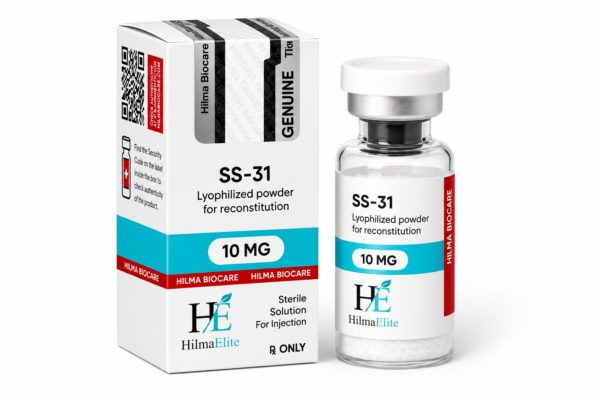
SS-31 10mg/vial (Elamipretide) Overview
HilmaElite SS-31 10mg is a premium research peptide supplied as a sterile, lyophilized (freeze-dried) powder in a single-use glass vial. Classified structurally as a small synthetic tetrapeptide, SS-31—also referred to as elamipretide 10mg or MTP-131—is distinguished by its ability to cross cell membranes and selectively concentrate in the inner mitochondrial membrane.
When researchers choose to buy ss 31 10mg from HilmaElite, they receive a carefully purified compound verified for batch consistency and sequence integrity. Designed specifically for laboratory evaluation, each vial provides a precise 10mg quantity suitable for controlled experimental protocols investigating cellular energy production, mitochondrial integrity, and targeted antioxidant pathways.
Product Specifications & Technical Overview
| Feature | Specification |
| Product Name | SS-31 10mg/vial |
| Common Aliases | Elamipretide, MTP-131, Szeto-Schiller 31 |
| Peptide Sequence | D-Arg-Dmt-Lys-Phe-NH2 |
| Format / Form | Lyophilized powder in a sealed glass vial |
| Unit Concentration | 10mg per vial |
| Purity Grade | Research grade (high-performance liquid chromatography verified) |
| Storage Instructions | Lyophilized: Store frozen at -20°C. Reconstituted: Keep refrigerated at 2–8°C; use within recommended research timelines. |
| Category | Injectable Peptides / Research Peptides |
Why Researchers Study SS-31 (Elamipretide)
Mitochondria generate the vast majority of cellular ATP required for physiological function. However, as cells undergo metabolic stress, aging, or ischemia, mitochondrial efficiency decreases while reactive oxygen species (ROS) increase.
Investigators exploring mitochondrial bioenergetics frequently choose to buy ss-31 peptide online due to its targeted activity inside the cell. Unlike traditional antioxidants that broadly clear free radicals throughout the cytoplasm, SS-31 specifically targets cardiolipin—a unique phospholipid found almost exclusively on the inner mitochondrial membrane.
Primary research areas involving the ss 31 peptide 10mg format include:
-
Mitochondrial Membrane Stability: Investigating how binding to cardiolipin helps preserve inner mitochondrial structure (cristae curvature) under stress conditions.
-
Cellular Energy Optimization: Evaluating ATP production capacity in models of metabolic dysfunction or cellular strain.
-
Reduction of Oxidative Stress: Studying targeted ROS suppression at the primary site of cellular electron leakage.
-
Ischemia & Reperfusion Injury: Analyzing tissue recovery and cell survival protocols following oxygen deprivation.
Understanding the Science: How SS-31 Interacts with Mitochondria
To evaluate the ss-31 10mg peptide effectively, it helps to understand its localized mode of action in simple terms:
-
Selective Penetration: The amino acid structure of SS-31 allows it to freely penetrate cell membranes and concentrate hundreds-fold within the inner mitochondrial membrane.
-
Cardiolipin Binding: SS-31 binds electrostatically and hydrophobically to cardiolipin. Cardiolipin is essential for electron transport chain cluster assembly and cristae structure.
-
Restoring Electron Flow: By stabilizing cardiolipin, SS-31 helps maintain optimal spatial arrangement between respiratory chain complexes, supporting efficient electron transfer and limiting excessive radical formation.
By restoring structural order to the inner membrane rather than attempting to alter gene expression or uncouple respiration, SS-31 serves as a novel model for structural mitochondrial restoration.
Reconstitution & Practical Handling Guidelines
Handling lyophilized peptides accurately ensures experimental repeatability:
-
Reconstitution: Slowly add sterile bacteriostatic water or normal saline along the inside glass wall of the ss 31 10mg vial. Swirl gently until the cake is fully dissolved; do not shake vigorously to avoid destabilizing the peptide chain.
-
Solubility: SS-31 exhibits high water solubility due to its aromatic-cationic peptide architecture.
-
Storage & Stability: Store un-reconstituted vials in a freezer at -20°C, protected from light and moisture. Once reconstituted, handle under aseptic laboratory conditions and maintain at 2–8°C.
Practical Considerations Before Ordering
Before ordering ss 31 10mg online, researchers and laboratory administrators should consider the following parameters:
-
Purity & Integrity: Ensure your supplier provides batch-tested peptides with documented purity levels to avoid baseline interference in assays.
-
Storage Preparation: Have dedicated low-temperature storage (-20°C or below) and sterile reconstitution media available prior to product delivery.
-
Experimental Scope: Calculate required vial quantities based on planned concentration levels and assay volume requirements.
Frequently Asked Questions (FAQ)
What is SS-31 (Elamipretide)?
SS-31, also known as Elamipretide or MTP-131, is a synthetic tetrapeptide designed to selectively target cardiolipin on the inner mitochondrial membrane. It is primarily researched for its role in mitochondrial structural support and oxidative stress reduction.
What is the difference between SS-31 and Elamipretide?
There is no difference in chemical identity. SS-31 is the initial laboratory designation (Szeto-Schiller peptide 31), while Elamipretide is the adopted generic international nonproprietary name (INN) for the exact same active compound.
How is the HilmaElite SS-31 10mg vial packaged?
HilmaElite supplies ss 31 10mg as a sterile, freeze-dried (lyophilized) cake or powder sealed in a glass vial under inert atmospheric conditions to maintain maximum stability during transit.
How should SS-31 10mg be stored upon arrival?
Upon arrival, dry lyophilized vials should be stored at -20°C or lower, protected from direct light. Once reconstituted with a liquid diluent, keep the solution refrigerated between 2°C and 8°C.
Where can I buy SS-31 peptide online for research?
You can order verified ss 31 10mg vials directly through HilmaElite. All product batches undergo quality control checks to ensure sequence accuracy and analytical purity for laboratory research.

Reviews
There are no reviews yet.