
🚚 Fast & Discreet Delivery
Understanding Peptide Reconstitution: A Beginner’s Guide
Learn what peptide reconstitution means, why many peptides come as freeze-dried powders, and the role of bacteriostatic water in this beginner-friendly guide.

If you’ve been researching peptides, you’ve probably come across the word “reconstitution.”
For many beginners, it’s one of the most confusing parts of learning about peptide therapies.
What does it actually mean?
Why do some peptides come as a powder instead of a liquid?
What is bacteriostatic water, and why is it often mentioned alongside peptides?
The good news is that the idea is much simpler than it sounds.
In this guide, we’ll explain peptide reconstitution in plain English—without complicated medical jargon. You’ll learn why some peptides require reconstitution, the role of bacteriostatic water, how these products are commonly stored, and the basic safety principles everyone should understand before using peptide-based therapies.
Whether you’re researching peptides for the first time or comparing treatments like Semaglutide and Tirzepatide, understanding reconstitution helps you better understand how many peptide products are supplied.
Quick Answer
Peptide reconstitution simply means adding a sterile liquid to a freeze-dried peptide powder so it becomes a liquid again.
Many peptide products are supplied as a powder because this helps keep them stable during storage and transport. The liquid used is commonly Bacteriostatic Water 10ml, which is specially made for this purpose.
The exact preparation method, storage instructions, and handling requirements vary between products, so always follow the instructions provided by the manufacturer or your healthcare provider.
What Does “Peptide Reconstitution” Mean?
Let’s start with the word itself.
Reconstitution simply means returning something to its original form.
Many peptide medicines are manufactured as a dry powder. Before they’re used, that powder is combined with a sterile liquid so it becomes a solution again.
Think of it like making powdered hot chocolate.
The powder stays stable in the container until you add liquid. Once mixed, it’s ready to use according to the product’s instructions.
Peptides work in a similar way, although they require sterile handling because they’re medical products.
If you’re new to peptides altogether, our What Are Peptides? A Beginner’s Guide explains what peptides are, how they work, and why they’re used in modern medicine.
Why Are Some Peptides Sold as a Powder?
One of the first questions people ask is:
“Why don’t manufacturers just sell every peptide as a liquid?”
The answer comes down to stability.
Many peptides are delicate molecules.
When stored as a liquid for long periods, they may gradually lose their stability or become less effective over time.
By removing the water during manufacturing—a process called freeze-drying—the peptide can often remain stable for longer when stored correctly.
That’s why many products are commonly supplied as freeze-dried powders before preparation.
This approach also helps manufacturers transport and store many peptide products more efficiently.
What Is Bacteriostatic Water?
If you’ve spent any time reading about peptides, you’ve probably seen people mention bacteriostatic water.
It sounds technical, but the idea is straightforward.
Bacteriostatic water is sterile water that contains a small amount of benzyl alcohol. The benzyl alcohol helps reduce the growth of bacteria after the vial has been opened, which is why it’s commonly used when preparing certain medications.
HilmaElite offers Bacteriostatic Water 10ml, which is designed for applications where bacteriostatic water is appropriate.
It’s important to remember that not every medication should be prepared with bacteriostatic water. The correct diluent depends on the specific product, so always follow the manufacturer’s instructions or your healthcare provider’s guidance.
What Equipment Is Commonly Used?
People often wonder what items are typically involved when a peptide product requires reconstitution.
While the exact requirements depend on the product, they commonly include:
- The peptide vial
- The recommended sterile diluent (such as Bacteriostatic Water 10ml, when appropriate)
- Sterile handling equipment, as specified by the product instructions
- A clean preparation area
Using clean equipment and following the instructions supplied with the product are important steps in helping reduce the risk of contamination.
Why Does Sterile Handling Matter?
Unlike a vitamin tablet that you simply swallow, peptide products require careful handling.
Once a sterile product has been opened, keeping it clean becomes important.
Even tiny amounts of contamination that aren’t visible to the eye can affect a sterile medication.
That’s why healthcare professionals emphasize:
- Washing hands thoroughly.
- Working in a clean environment.
- Following the product instructions carefully.
- Avoiding unnecessary handling of sterile components.
These simple habits help protect the quality of the product and reduce the risk of contamination.
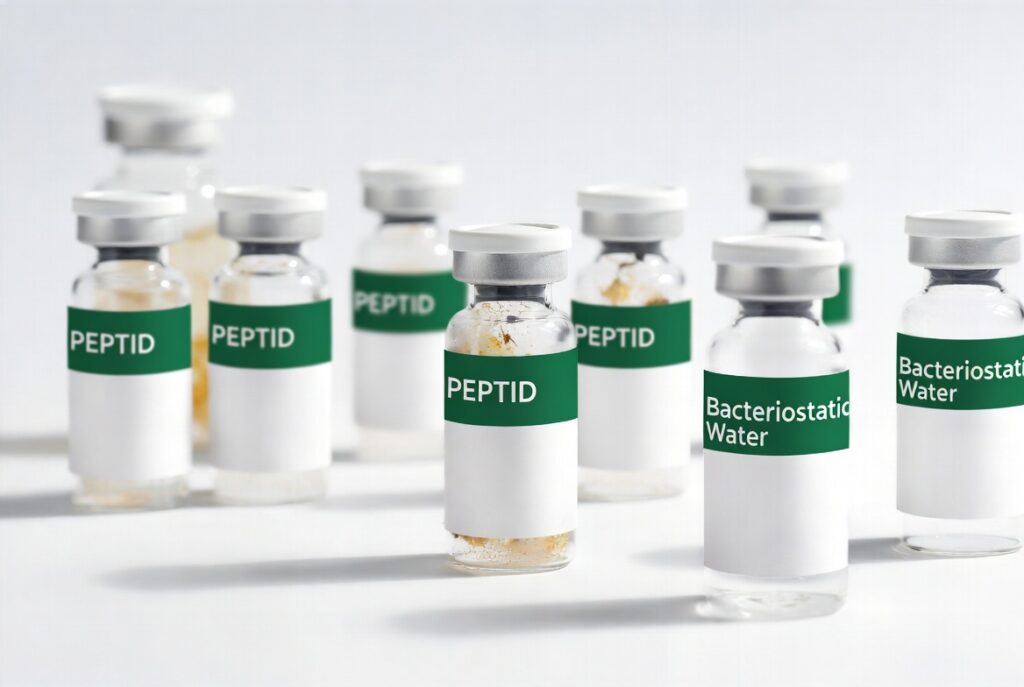
A clean, premium medical editorial illustration showing several labeled freeze-dried peptide vials beside a vial of Bacteriostatic Water on a bright white clinical surface. Modern healthcare aesthetic with soft lighting, minimal design, white and green color palette, no syringes, no injections, no mixing process, highly professional and trustworthy.
Common Myths About Peptide Reconstitution
If you’ve spent any time reading online forums or watching videos, you’ve probably come across a lot of conflicting advice about peptide reconstitution.
Some of it is helpful—but a lot of it is misleading.
Let’s clear up a few common myths.
Myth 1: Every Peptide Is Reconstituted the Same Way
This is one of the biggest misunderstandings.
Different peptides are made by different manufacturers, and they may have different formulations, storage requirements, or preparation instructions.
For example, products such as Semaglutide, Tirzepatide, and BPC-157 are different products and should always be handled according to the instructions provided for each one.
Assuming every peptide should be treated the same can lead to mistakes.
Myth 2: Powder Means the Product Is Incomplete
Some people think a vial containing powder means something is missing.
That’s not true.
Many peptide medicines are intentionally manufactured as freeze-dried powders because this helps preserve their quality during storage and transport.
Receiving a peptide as a powder is completely normal for many products.
Myth 3: Bacteriostatic Water Is the Same as Ordinary Sterile Water
These terms are often used interchangeably online, but they are not the same.
Bacteriostatic Water 10ml contains a small amount of benzyl alcohol, which helps slow the growth of bacteria after opening. Ordinary sterile water does not contain this preservative.
The appropriate diluent depends on the specific medication, so always follow the instructions supplied with your product or the advice of your healthcare professional.
Why Proper Storage Matters
Peptides are sensitive biological molecules.
Like many medicines, they can be affected by heat, light, and improper storage.
That’s why manufacturers provide storage instructions for each product.
Following those recommendations helps maintain product quality throughout its intended shelf life.
How Long Do Reconstituted Peptides Last?
This is one of the most frequently searched questions online.
The honest answer is:
It depends on the product.
There isn’t a single shelf-life that applies to every peptide.
Factors that can influence stability include:
- The specific peptide.
- The manufacturer’s formulation.
- The recommended diluent.
- Storage conditions.
- The manufacturer’s instructions after preparation.
Rather than relying on advice from forums or social media, always follow the storage and expiry information supplied with your product.
Why You Should Avoid Guessing
The internet is full of videos, charts, and dosing calculators that claim to provide a “universal” method for preparing peptides.
The reality is much simpler:
There is no one-size-fits-all approach.
If different sources are giving you different answers, that’s often a sign that the advice is being generalized across products that aren’t actually the same.
When in doubt, rely on the product information provided by the manufacturer or consult a qualified healthcare professional instead of online anecdotes.
Related Peptides You May Come Across
As you learn more about peptide therapy, you’ll probably come across many different names.
Some are researched for weight management, while others are studied for areas such as recovery, growth hormone support, or metabolic health.
Examples include:
If you’re unfamiliar with these names, our What Are Peptides? A Beginner’s Guide is a great place to start before exploring individual peptide products.
Key Takeaways
If you’re new to peptide therapy, these are the most important points to remember:
- Peptide reconstitution means returning a freeze-dried peptide to a liquid form before use, where required.
- Not every peptide product is prepared or handled in the same way.
- Bacteriostatic Water is a specific product and is different from ordinary sterile water.
- Always follow the manufacturer’s instructions for your specific product.
- Be cautious about advice from social media or discussion forums.
- Understanding the basics helps you have more informed conversations with your healthcare provider.
Frequently Asked Questions (FAQ)
Do all peptides need to be reconstituted?
No.
Some peptides are supplied as a freeze-dried powder and require reconstitution before use, while others are available in ready-to-use liquid formulations or prefilled pens.
For example, HilmaElite offers products such as Semaglutide Pen 5mg/3ml, which is already supplied as a liquid, alongside freeze-dried peptide products like Semaglutide 2mg – 1 Vial and Tirzepatide 10mg – 1 Vial. Always check the product description and manufacturer’s instructions for the specific product you’re using.
Why are many peptides sold as powders?
Freeze-drying helps improve the stability of many peptide products during storage and transport.
Keeping the peptide in a dry form until it’s prepared for use can help preserve its quality. The exact reason may vary depending on the product and manufacturer.
What is bacteriostatic water used for?
Bacteriostatic Water is a sterile water product containing a preservative that helps reduce bacterial growth after opening. It is commonly used when a product specifically calls for bacteriostatic water, but the correct diluent always depends on the manufacturer’s instructions.
Can I use the same preparation method for every peptide?
No.
Different peptide products may have different formulations, storage requirements, and manufacturer instructions. Always follow the information provided with your specific product instead of assuming the same approach applies to every peptide.
Where can I learn more about peptides?
If you’re just getting started, read our What Are Peptides? A Beginner’s Guide, which explains what peptides are, how they work, and the different types you’ll commonly encounter before diving into individual products.
Final Thoughts
Peptide reconstitution may sound intimidating at first, but understanding the concept doesn’t have to be complicated.
At its core, it’s simply a way that many peptide products are manufactured and supplied to help maintain their quality until they’re prepared according to the manufacturer’s instructions.
The most important takeaway isn’t memorizing technical terms—it’s understanding that different peptide products can have different requirements. Rather than relying on advice from forums or social media, look for reliable information from product documentation and qualified healthcare professionals.
As you continue learning about peptides, you’ll also discover that they’re used in a wide range of research and medical fields, from metabolic health to hormone-related therapies. Taking the time to understand the basics now will make it much easier to evaluate information and ask informed questions in the future.
Continue Your Learning
If you found this guide helpful, you may also be interested in: